
Recent Posts




Droopy Eyelids
Blog by Ivan J. Srut, O.D.
Chief of Optometry for St. Hope Foundation
Droopy eyelids are a topic I don’t believe I’ve covered during my time at St. Hope Foundation, but since my wife had surgery to correct this problem I thought it might be an interesting one to cover.
Unfortunately, over time, Mother Nature can be unkind(along with gravity), and our eyelids end up “droopy” or “drooping”! There can be other causes such as stoke, muscle issues, Bell’s palsy, etc. For the purpose of keeping this blog short, I am going to focus on a more natural type called Dermatochalasis.
Dermatochalasis is an excess of skin in the upper or lower eyelid, and can also be known as “baggy eyes”. It can be acquired or congenital. It is caused by a loss of elasticity in the tissue supporting the eyelid. This leads to stretching of the eyelid, sometimes making it appear that the person has extra eyelid skin, and this can affect a person’s field of vision.
Some insurance will cover the procedure if the droopy eyelids affect a person’s visual field enough to affect their lives negatively enough in predetermined amounts. Some people don’t wait until the eyelids get to this level and choose to do surgery on their own. The procedure done is called blepharoplasty, also known as an “eye lift”.
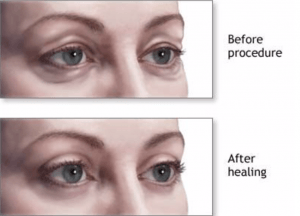
Blepharoplasty is a procedure that removes the excess skin around the eye before then attaching the remaining skin to healthy connective tissue. Cuts are done in the natural folds of the eyes to minimize or eliminate the appearance of scars after the procedure. After Blepharoplasty there is healing time of weeks to months, depending on the individual. Medications for healing and pain are given, along with eye drops and ointments, along with antibiotics to keep the eyes lubricated, and to keep them from getting infected, respectively. Icing is important to decrease the swelling in the first week, then heat is applied to help the healing process in the following week. Below is a picture of a before and after picture, although the before is not a severe case of Dermatochalasis. The patient appears to have an extra eyelid in the right and left upper lids, and also a little bit of sagging of both lower eyelids. After the procedure the difference is very visible.
For anyone that has gotten to this point with their own eyes, or has a friend or family member in this situation, I would be happy to see them and refer them to an eye surgeon to remedy it. Contact our vision department any time and set up an appointment!
Until next time…